Our English Curriculum:
Intent
At Duke Street Primary School, our overarching aim for English is to promote high standards of language and literacy by equipping our pupils with a strong command of the spoken and written word, and to develop their love of literature through widespread reading for enjoyment.
We aim to ensure that all of our pupils:
- Read easily, fluently and with good understanding
- Develop the habit and love of reading widely and often, for both pleasure and information
- Acquire a wide vocabulary, an understanding of grammar and knowledge of linguistic conventions for reading, writing and spoken language
- Appreciate our rich and varied literary and cultural heritage
- Write clearly, accurately and coherently, adapting their language and style in and for a range of contexts, purposes, audiences and cultures
- Use discussion in order to learn; they should be able to elaborate and explain clearly their understanding and ideas
- Are competent and confident in the arts of speaking and listening, making formal presentations, demonstrating to others and participating in debate
Reading
In addition to our direct teaching of reading through our shared and guided reading sessions, we encourage children to read for pleasure and each child has the opportunity for independent and class reading each day through our daily ERIC (Everybody Reading in Class) and class novel sessions.
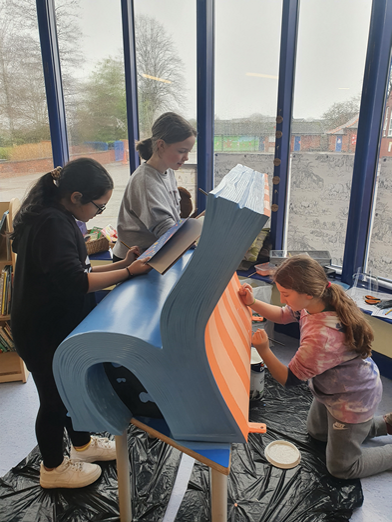
Throughout the school year, the importance of reading and writing is also enhanced through World Book Day, author and poet visits and in-house school reading events organised by English Ambassadors and a staff reading group. We also promote local community reading projects such as the Book Bench Project organised through Chorley Council scheme- ‘What’s Your Story Chorley?’
Home Reading
Our home reading scheme contains a blend of decodable and non-decodable books and we encourage children to read a variety of texts to ensure a balance between poetry, fiction and non-fiction. Home readers are matched to the child’s phonetic development and reading ability, which is in line with our progression in phonics. Our scheme develops greater independence and fluency in a child’s reading. We also emphasise to parents and guardians the importance of questioning and understanding of texts to support a child’s developing comprehension.
Examples of the schemes used in guided reading:
- Collins – Sky Racer / Spotlight/ Big Cat
- Longman – The Book Project
- Oxford Reading Tree / Songbirds
- Pearson – Phonics Bug
- Examples of the schemes used for home reading:
- Early Readers
- Oxford Reading Tree / Songbirds/ Tree Tops
- Wolf Hill
- Project X
- Collins – Sky Racer
Reading Eggs
Reading Eggs makes learning essential reading and phonics skills fun and is very interactive.
The programme uses a highly motivating sequence of online reading lessons, activities and books that keep pupils engaged and on task.
Children can access Reading Eggs at school during reading time and also when at home.
Writing
At Duke Street Primary School, we ensure that the teaching of writing is purposeful, robust and shows clear progression for all children. In line with the National Curriculum, each year group is taught the explicit grammar, punctuation and spelling objectives required for each age group. We carry out the curriculum planning for English in three phases (long-term, medium-term and short-term). The National Curriculum and the Statutory Framework for the Early Years Foundation Stage detail the objectives and genres to be covered each year. Our curriculum is carefully planned to engage and excite all pupils by our teachers mapping out and planning their year group’s English lessons. To support and guide their plans, teachers use and adapt ideas taken from Lancashire’s Scheme of Work and Lancashire’s Key Learning Indicators of Performance (KLIPs) to ensure that age appropriate skills and knowledge are taught across the school.
Kinetic Letters
Kinetic Letters information page for parents
At Duke Street Primary School, we follow a handwriting scheme called Kinetic Letters. This programme enables children to:
- Have stronger bodies
- Have the correct pencil hold
- Write letters and numbers fluently and legibly
The programme is designed to help flow and stamina in writing, preparing your child for writing across the curriculum which will increase as they get older. It is designed to stop the aching hand and increase motivation and automaticity in writing.
Please be aware that all resources are provided by Kinetic Letters and hold the copyright. We therefore ask you do not share or reproduce these documents. You can use them to support your child at home.
The letters are split up into families which help the pupils to correctly form each of the 26 letters of the alphabet.


The programme then moves onto joining which is developed throughout KS2. See the following video links for each of the families: Window Cleaner Family Video: https://www.youtube.com/watch?v=AaEsOI30axM&feature=emb_logo Jumper Family Video: Kinetic Letters (Jumper family) Year 1
Pencil Hold- We teach the children the “three friends hold”. The thumb and first finger sit on top of the pencil The third finger is called the pillow finger and sits underneath the pencil:


If you have any questions about Kinetic Letters – please ask your child’s class teacher.
English Ambassadors
We have very passionate English Ambassadors from Yr 2- Yr 6 who enjoy promoting reading and writing throughout the school. They deliver assemblies, visit classrooms, run a variety of clubs, read to children in EYFS and KS1 and help to plan many exciting English events throughout the school year.
English ambassadors
Events
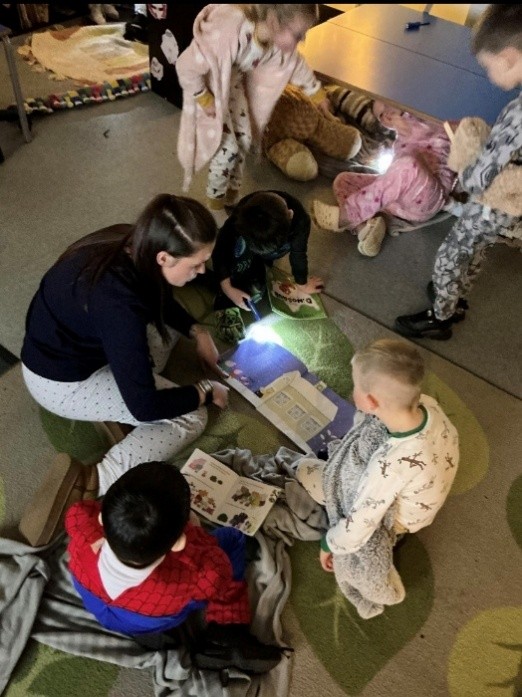
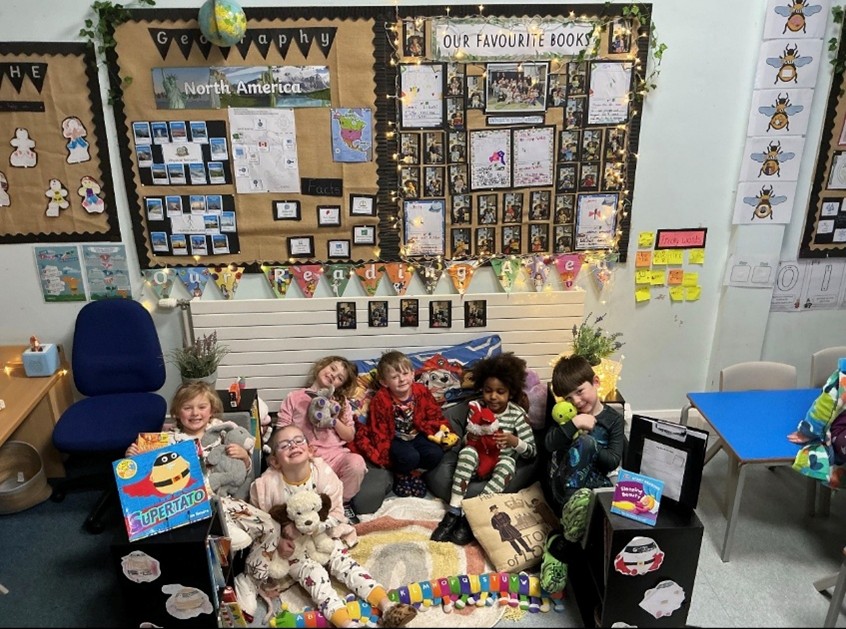
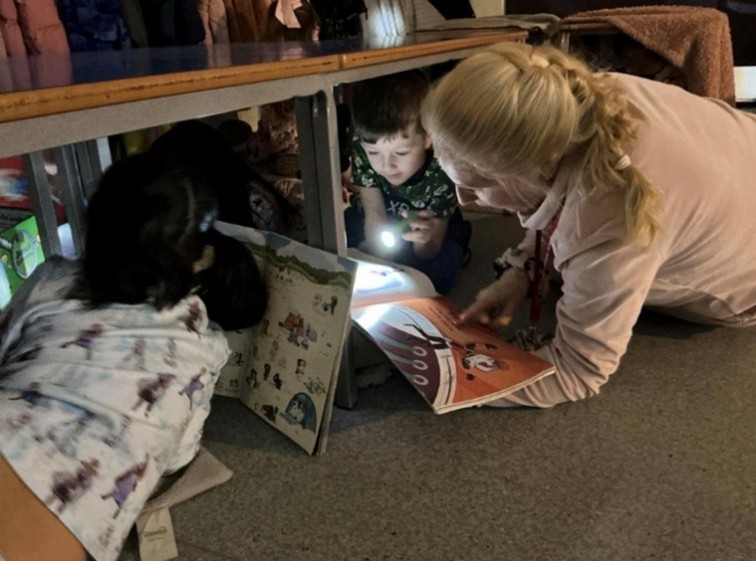
We had fabulous time celebrating World Book Day this year.
The children loved spending the day reading different texts and engaging with reading activities…all in their cosy pjs!
We look forward to more exciting reading events during the summer term!
World Book Day 26